
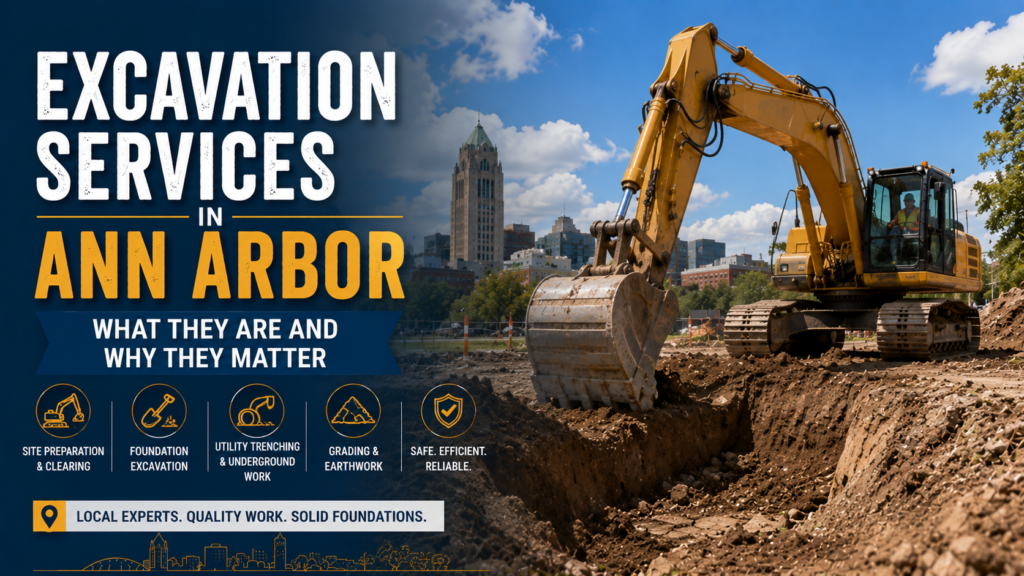
Excavation is the unseen foundation of the built environment. Every home, office building, road, parking structure, utility line, and drainage system in Ann Arbor begins its life in the ground and before any of it can be constructed, the earth must be moved, shaped, and prepared. Excavation Service Ann Arbor encompass the full range of earthwork required to create the conditions in which construction can succeed: from digging foundations and trenching for utilities to grading sites for proper drainage and compacting soil to engineering specifications.
Ann Arbor’s particular landscape shaped by glacial deposits, the Huron River watershed, clay-heavy soils, and the demands of a university city with dense development in some areas and wooded, rural character in others creates a distinctive set of excavation challenges. Understanding what professional excavation services involve, the types of work that require excavation, and why local expertise matters in this region helps property owners, builders, and developers make informed decisions when planning any project that involves the ground.
What Does an Excavating Contractor Do?
An excavating contractor is the professional responsible for earthwork: all activities involving the movement, shaping, and management of soil, rock, and fill material. The scope of a full-service excavating contractor in Ann Arbor typically includes site clearing and grubbing, topsoil stripping and stockpiling, mass excavation for building footprints, foundation excavation, trench excavation for utilities (water, sewer, gas, electric, telecommunications), site grading and slope management, drainage system installation, soil compaction and testing, and hauling of excess excavated material.
Before any excavation begins, an excavating contractor conducts a site assessment to evaluate soil conditions, identify underground utilities, assess drainage patterns, and determine the appropriate equipment and methods for the work. This planning phase is where the contractor’s local knowledge of Washtenaw County’s soils, of Ann Arbor’s utility infrastructure, of the Huron River watershed’s drainage characteristics makes a tangible difference in project outcomes.
Types of Excavation Services in Ann Arbor
Foundation Excavation is among the most critical types of excavation work performed on any construction project. For a new residential or commercial structure, the foundation must be excavated to the precise depth and dimensions specified by the structural engineer, in soil that has been properly evaluated and prepared. In Ann Arbor, where clay soils are prevalent, foundation excavation requires careful attention to soil conditions. Clay soils can become unstable when saturated, and if the excavated soil is disturbed beyond the required depth, it may need to be recompacted or replaced with engineered fill before the foundation can be placed. An experienced excavating contractor knows how to manage the foundation excavation process to deliver a clean, stable, properly sized excavation on the first pass.
Trench Excavation for utilities water lines, sewer lines, storm drains, gas lines, electrical conduit, and telecommunications infrastructure is a routine but highly regulated type of excavation work. Before any trench is dug in Michigan, the Miss Dig utility notification system (Michigan’s version of the national 811 call-before-you-dig service) must be contacted at least three business days before digging begins. All underground utilities in the work area are then located and marked by the relevant utility operators, and excavation must proceed in a manner that avoids damaging the marked utilities. Deep trenching in excess of five feet requires specific safety systems to protect workers from cave-in hazards, as required by OSHA’s excavation safety standards.
Mass Excavation involves moving large volumes of earth to achieve the target grade across a broad site area. This is common on commercial and residential development sites where the natural terrain differs significantly from the finished grade called for in the engineering plans. Mass excavation requires both the equipment to move material efficiently and the knowledge to manage soil disposition determining which excavated material can be reused on site as fill, and which must be exported to appropriate disposal locations.
Grading and Drainage Work is closely related to excavation and is typically performed by the same contractor. Grading shapes the excavated and filled earth to the precise slopes and elevations required by the site plan, ensuring that surface water drains away from structures and toward designed drainage outlets. In Ann Arbor, where clay soils drain slowly and the Huron River watershed creates specific drainage constraints, proper grading is particularly important. Poorly graded sites in this environment can retain water, create foundation drainage problems, and generate regulatory issues related to stormwater management.
Septic System Excavation is a significant category of excavation work in the areas surrounding Ann Arbor where municipal sewer service is not available. Septic systems require precise excavation for the tank installation and the drain field distribution system, with careful attention to soil percolation rates and setback requirements from wells, property lines, and water bodies. The drain field must be excavated and graded to specifications established by the Washtenaw County Environmental Health division.
Ann Arbor’s Soil Conditions: What Every Excavator Must Know
Washtenaw County’s soils are the product of the last glaciation, which covered this part of Michigan approximately 10,000 years ago. The dominant soil type across much of the Ann Arbor area is clay-rich glacial till: dense, poorly draining, and highly responsive to moisture changes. These soils expand when wet and contract when dry, creating ground movement that can affect foundations, underground utilities, and any structure built upon or within them.
For excavation contractors working in Ann Arbor, this means several things in practice. Foundation excavations must be performed at the right moisture conditions neither so wet that the clay is unstable and unable to bear equipment without disturbance, nor so dry that the excavation walls are prone to cracking and spalling. Soil compaction of backfill material must account for the expansive nature of the native clay and may require the use of engineered granular fill rather than the excavated material for applications requiring predictable compaction behavior.
The clay soils also mean that Ann Arbor properties can experience significant drainage challenges. Areas where the natural topography is flat and much of the city’s terrain is quite level can accumulate surface water that has nowhere to drain. Good excavation and grading work addresses these drainage patterns proactively, establishing positive drainage away from structures and toward designed drainage infrastructure.
Working Near the Huron River Watershed
Ann Arbor sits within the Huron River watershed, and many properties in and around the city are adjacent to the river, its tributaries, or associated wetlands. Excavation work near these water features is subject to specific regulatory requirements. Michigan’s Inland Lakes and Streams Act and the state’s Floodplain Management regulations govern excavation and fill activities near waterways, and wetland disturbance is subject to the Goemaere-Anderson Wetland Protection Act and potentially federal Clean Water Act Section 404 jurisdiction.
A professional excavating contractor working in Ann Arbor is familiar with these regulatory frameworks and knows when a project’s proximity to water bodies or wetlands triggers a permitting requirement. Navigating these requirements correctly obtaining the appropriate permits, implementing the required mitigation measures, and documenting compliance protects property owners from regulatory liability and ensures that excavation work does not create downstream environmental impacts.
The 811 Call-Before-You-Dig Requirement
Michigan law requires that the Miss Dig system be notified at least three business days before any digging begins, regardless of the size or depth of the excavation. This notification system coordinates with all utility operators to have underground utilities located and physically marked on the ground surface before work begins. In Ann Arbor, with its dense network of underground infrastructure including DTE Energy gas and electric lines, City of Ann Arbor water and sewer mains, and a complex web of telecommunications conduits, this step is non-negotiable.
A professional excavating contractor manages the Miss Dig notification as part of their standard pre-excavation process, ensuring that the required advance notice is given, that all utility marks are documented, and that excavation equipment operators are briefed on the locations of marked utilities before work begins.
Final Thoughts
Excavation services are the bedrock of every construction project in Ann Arbor, and the quality of excavation work directly determines the stability, drainage, and long-term performance of everything built upon it. Understanding the types of excavation work, the specific challenges posed by Ann Arbor’s clay soils and Huron River watershed context, and the regulatory framework governing excavation and utility work in Michigan and Washtenaw County helps property owners and developers engage more effectively with their excavating contractor and set their projects up for success from the ground up.
Excavation Service Ann Arbor